


Daily Lecture 003 · 2026-11-06
Haemorrhoids: grade, stage, then match the treatment
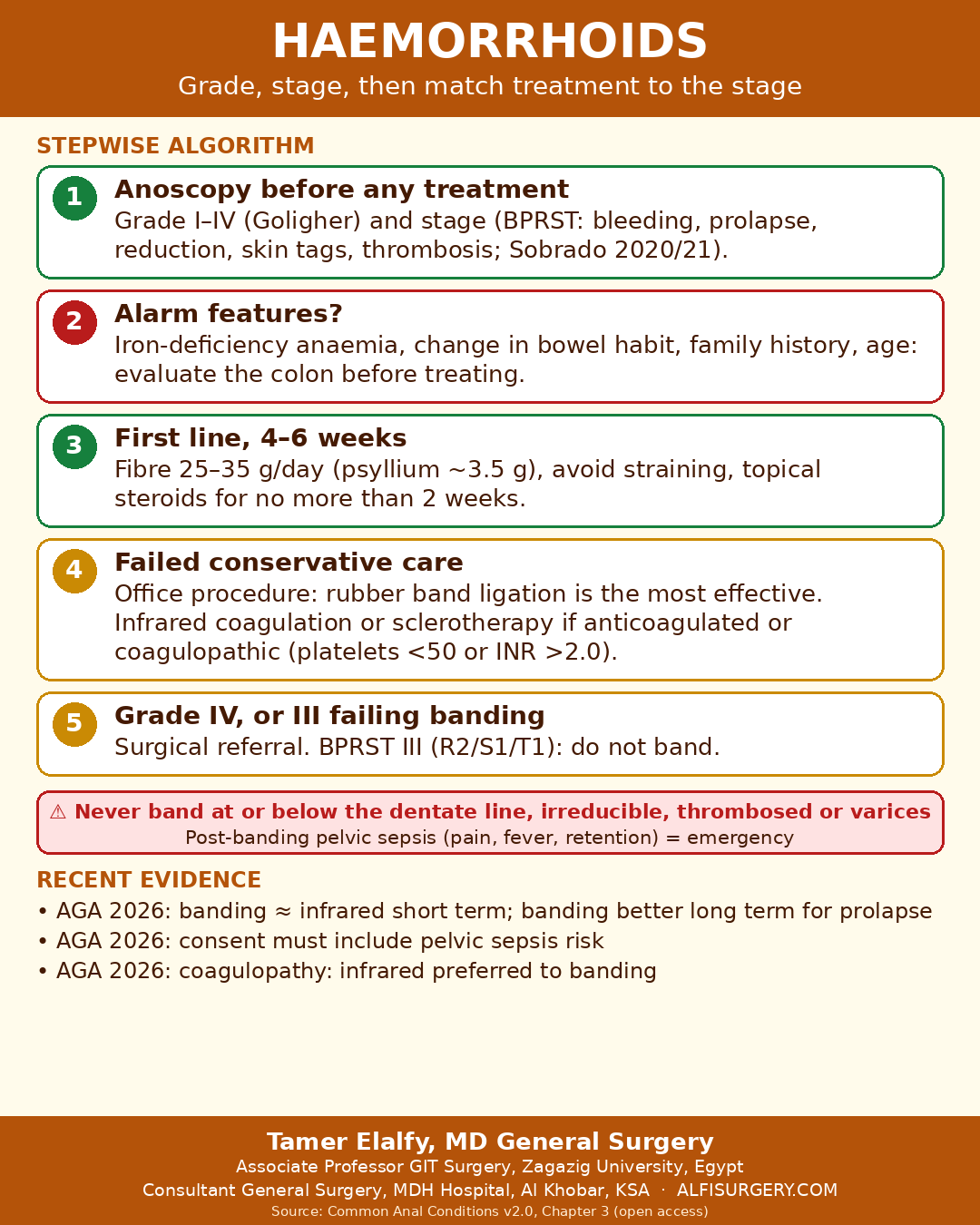
Haemorrhoid treatment should follow the stage, not the symptom list. Anoscopy (looking inside the back passage with a short small tube and light) first, alarm features second.
Stepwise approach (adapted from Common Anal Conditions v2.0, Chapter 3)
- Anoscopy before any treatment. Grade I–IV (Goligher) and stage (BPRST: bleeding, prolapse, reduction, skin tags, thrombosis; Sobrado 2020/21).
- Alarm features?. Iron-deficiency anaemia, change in bowel habit, family history, age: evaluate the colon before treating.
- First line, 4–6 weeks. Fibre 25–35 g/day (psyllium ~3.5 g), avoid straining, topical steroids (strong medicines that reduce swelling and calm the immune system) for no more than 2 weeks.
- Failed conservative care. Office procedure: rubber band ligation is the most effective. Infrared coagulation (using focused heat light on a pile to shrink it, without cutting) or sclerotherapy (an injection that shrinks swollen tissue by hardening it from inside) if anticoagulated or coagulopathic (platelets <50 or INR >2.0).
- Grade IV, or III failing banding (a clinic treatment tying a small rubber ring around swollen tissue). Surgical referral. BPRST (a doctor's scoring system describing piles by bleeding, slipping out, tags and clots) III (R2/S1/T1): do not band.
Recent evidence
- AGA Clinical Practice Update 2026: rubber band ligation and infrared coagulation have similar short-term benefit; banding (placing a tiny tight band around a haemorrhoid so it shrinks and falls away) gives longer-term benefit for prolapse (something slipping down or pushing out from where it should normally stay) and recurrent bleeding; use either before haemorrhoidectomy (an operation to cut away swollen cushions around the back passage) for grades 1 to 3.
- AGA 2026: counsel every patient about the small risk of pelvic sepsis (a serious infection deep in the pelvis, the lower inside part of the tummy) after banding and instruct immediate emergency assessment if symptoms appear.
- AGA 2026: in significant coagulopathy (platelets <50,000/µL or INR >2.0), infrared coagulation is preferred to banding; ASCRS 2024 guidelines frame the same stepwise approach.
Caution: Never band at or below the dentate line (a border inside the back passage above which feeling is dull and below which it is sharp), irreducible, thrombosed or varices. Post-banding pelvic sepsis (pain, fever, retention) = emergency.
Free open-access book: /books/common-anal-conditions/chapter-03
Educational content for healthcare professionals. Follow local guidelines and the treating team's judgement.
References
- Qureshi W et al. AGA Clinical Practice Update on Diagnosis and Treatment of Hemorrhoids: Expert Review. Clin Gastroenterol Hepatol 2026;24(7):1773-1781. doi:10.1016/j.cgh.2026.04.008
- Hawkins AT et al. ASCRS Clinical Practice Guidelines for the Management of Hemorrhoids. Dis Colon Rectum 2024;67(5):614-623. doi:10.1097/DCR.0000000000003276