

Stapled haemorrhoidopexy: lifting bleeding internal piles back into place
A day-case operation for bleeding internal haemorrhoids that I have performed for about ten years, with the drawings below to show what happens.
What the operation does
Internal haemorrhoids are cushions of tissue inside the anal canal. When they slip down, they bleed and can prolapse.
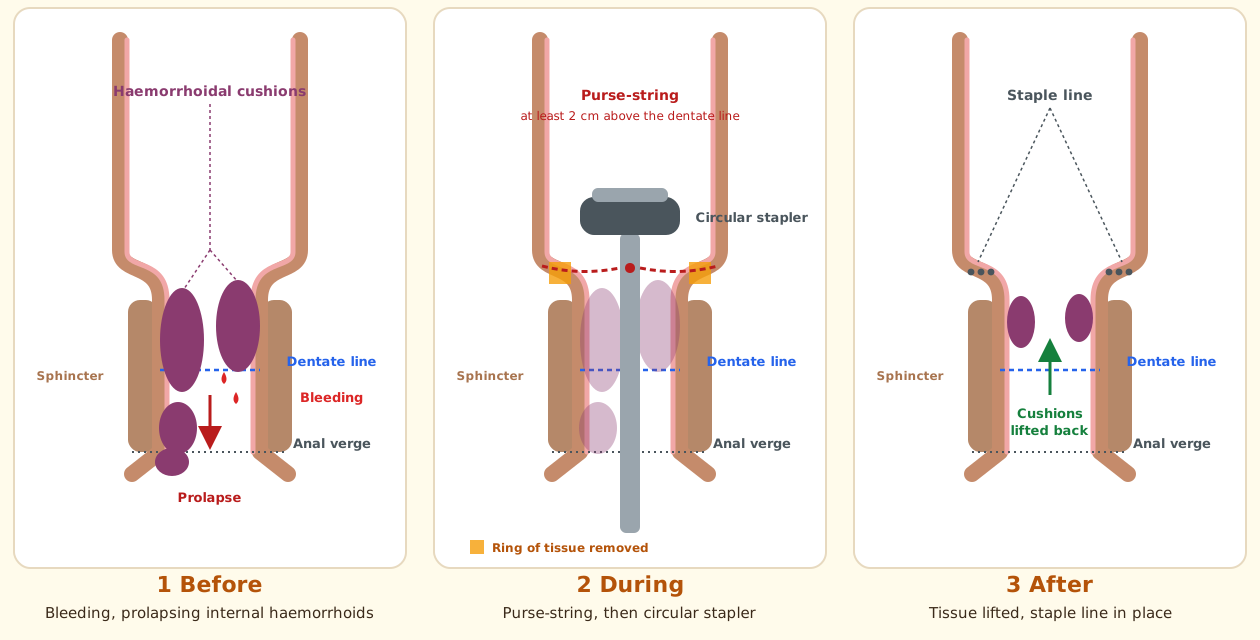
In stapled haemorrhoidopexy a circular stapler lifts the slipping tissue back to its normal position and fixes it there. A thin ring of tissue is removed above the dentate line, where the lining has little pain sensation, so the operation does not cut the sensitive skin around the anus.
Who it may suit
People with bleeding internal haemorrhoids that slip down (prolapse), when rubber-band treatment and simple measures have not been enough.
It is not for everyone. Large external skin tags, a lot of external disease, some other anal conditions and certain health problems change the choice. This is decided at consultation after an examination.
The three steps in the drawing
- Before: the cushions are enlarged, slip down, and bleed.
- During: a purse-string stitch is placed at least 2 cm above the dentate line, then the circular stapler removes a ring of tissue and joins the edges in one movement.
- After: the cushions are lifted back to where they belong and a staple line sits well above the dentate line.
What recovery is like in my experience
In my practice most patients go home the same day, have little pain compared with traditional excision surgery, and return to full activity around the second day.
This is my own clinical experience over about ten years. Individual recovery differs, so follow the instructions you are given.
An honest note on the evidence
Large studies show less early pain and a quicker return to normal life than traditional excision, but the problem can come back more often over the years than after excision. Current guidelines usually keep stapled haemorrhoidopexy for selected patients rather than as the first treatment for everyone.
Rare but serious complications have been reported, including bleeding, pain that does not settle, urgency, and, very rarely, infection or damage to the rectal wall. Careful technique and careful selection matter.
I do not claim it is better than every other option. It is one good option, in the right patient, in experienced hands.
Seek urgent help if
- You bleed heavily or pass clots.
- You have fever, severe or increasing pain, or you cannot pass urine.
- You have severe pain in the pelvis or lower abdomen after the operation.
This page gives general information and does not replace an examination and the advice of your treating surgeon.