


Daily Lecture 005 · 2026-11-12
Rectal bleeding: triage first, never assume haemorrhoids
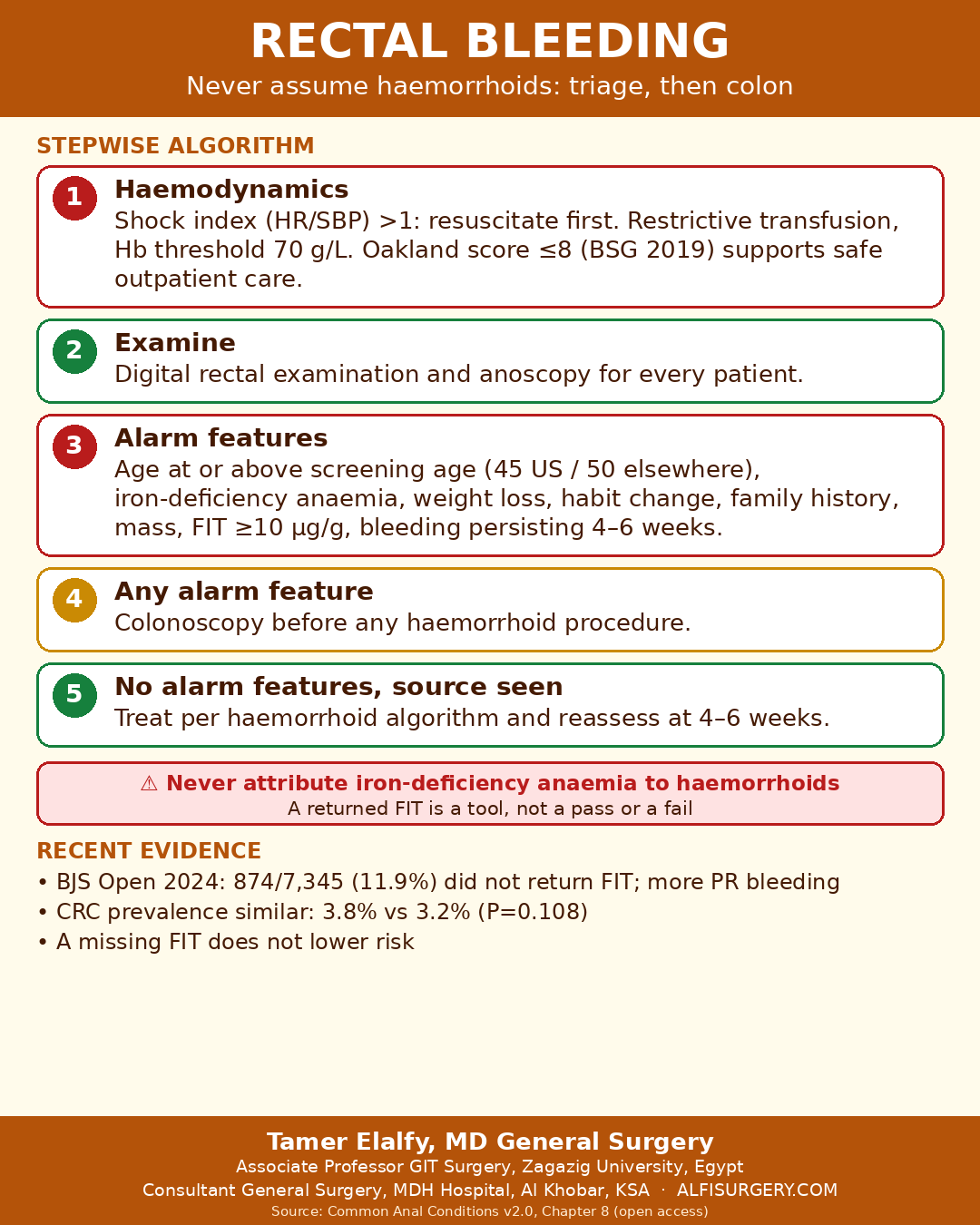
Rectal bleeding is a symptom, not a diagnosis. Haemorrhoids are the last explanation to accept, not the first.
Stepwise approach (adapted from Common Anal Conditions v2.0, Chapter 8)
- Haemodynamics. Shock index (HR/SBP) >1: resuscitate first. Restrictive transfusion, Hb threshold 70 g/L. Oakland score (a doctor's score for bleeding from the back passage, judging if hospital care is needed) ≤8 (BSG 2019) supports safe outpatient care.
- Examine. Digital rectal examination (the doctor gently feeling inside the back passage with a gloved finger) and anoscopy (looking inside the back passage with a short small tube and light) for every patient.
- Alarm features. Age at or above screening age (45 US / 50 elsewhere), iron-deficiency anaemia, weight loss, habit change, family history, mass, FIT (a home stool test that looks for hidden blood, used to check bowel health) ≥10 µg/g, bleeding persisting 4–6 weeks.
- Any alarm feature. Colonoscopy (a thin flexible camera passed through the back passage to inspect the large bowel) before any haemorrhoid procedure.
- No alarm features, source seen. Treat per haemorrhoid algorithm and reassess at 4–6 weeks.
Recent evidence
- BJS Open 2024 (7,345 patients referred on urgent or suspected-cancer pathways): 874 (11.9%) did not return a FIT; non-returners were younger and more often reported per-rectal bleeding.
- Colorectal cancer prevalence over a median 25 months was similar in non-returners and returners (3.8% vs 3.2%, P=0.108).
- Lesson: a missing FIT does not lower risk; investigate by symptoms regardless.
Caution: Never attribute iron-deficiency anaemia to haemorrhoids. A returned FIT is a tool, not a pass or a fail.
Free open-access book: /books/common-anal-conditions/chapter-08
Educational content for healthcare professionals. Follow local guidelines and the treating team's judgement.
References
- Gerrard AD et al. Colorectal cancer prevalence in faecal immunochemical test non-returners. BJS Open 2024;8(5). doi:10.1093/bjsopen/zrae119
- Oakland score (BSG 2019) and alarm-feature thresholds as summarised in Common Anal Conditions v2.0, Chapter 8